

Types of OCD: A Guide to Finding Real Relief
Obsessive-Compulsive Disorder (OCD) is a mental health condition that affects millions of individuals worldwide, causing distressing thoughts and repetitive behaviors. While OCD manifests in various forms, this article sheds light on four common types and their associated symptoms. Delve into the intricate workings of the mind as we unravel the complexities of OCD, offering insight into the challenges faced by those living with this disorder.
Clinically Reviewed by Lauren Barry, LMFT, MCAP, QS
Medically Reviewed by Ali Nikbakht, PsyD
Updated on January 10, 2026 — Editorial Policy | Research Policy

Obsessive-Compulsive Disorder (OCD) touches millions of lives. You might picture someone washing hands over and over. Yet OCD shows up in many ways. This mental health condition brings unwanted thoughts, images or urges. These spark anxiety. People with OCD then perform repetitive behaviors or mental acts to ease that fear.
We know the struggle feels real. At We Level Up Washington, we help you face different types of OCD with care and proven tools. Let’s explore what OCD looks like and how treatment works.
Skip To
Table of Contents
What Exactly Is OCD?
OCD isn’t about being neat or quirky. It hits when your brain gets stuck in a loop of obsessions and compulsions.
Obsessions are intrusive thoughts, images, or urges that pop up uninvited and spark intense anxiety. They’re not just worries – they feel urgent and terrifying, even when you know they’re irrational.
Compulsions are the behaviors or mental acts you do to quiet those obsessive thoughts. Checking the stove multiple times. Washing hands until they crack. Repeating phrases in your head. They bring short-term relief but feed the cycle long-term.
People with OCD spend hours a day trapped in this loop. It steals joy from work, relationships, and simple things like leaving the house.
But here’s the truth: OCD is treatable. More on that soon.
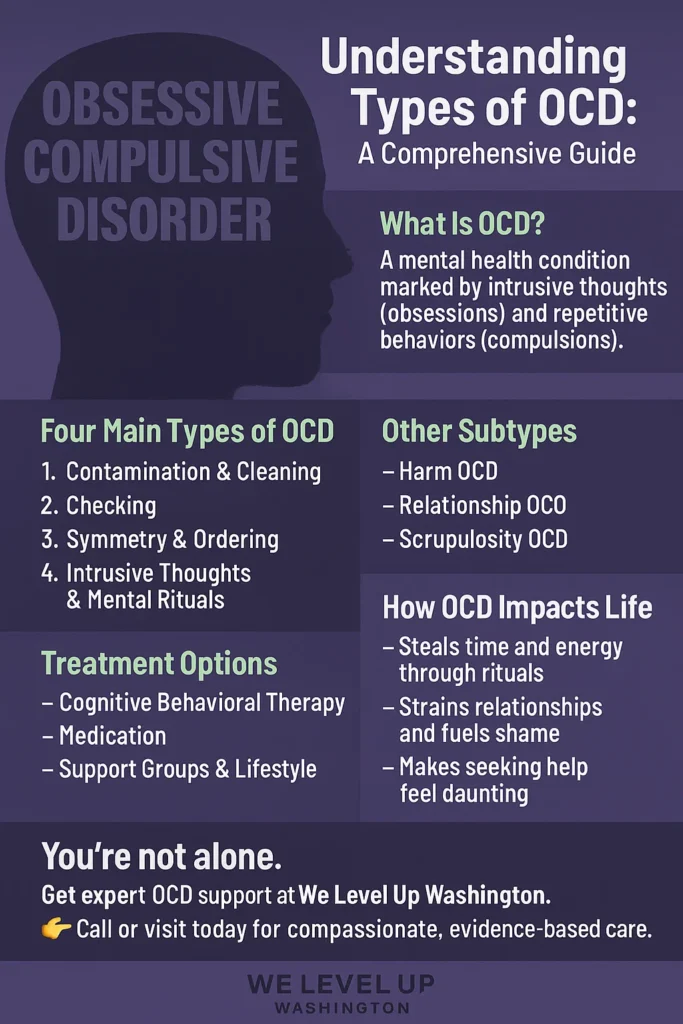
Why Recognizing OCD Types Matters
Types of OCD don’t look the same for everyone. Knowing your main type helps you understand why certain thoughts or rituals dominate your day. It also guides treatment – what works best for contamination fears might differ from what helps intrusive thoughts.
Researchers group symptoms into themes. While symptoms can overlap or shift over time, most fall into these categories. The dual diagnosis program offers integrated care that supports both the psychological and biological sides of OCD

The Main Types of OCD Disorders (And What They Feel Like)
Contamination OCD
You fear germs, dirt, chemicals, or mental contamination from bad thoughts or people. The idea of touching a doorknob or shaking hands sends panic through you.
Common obsessions:
- Getting sick or making loved ones sick
- Feeling dirty after a negative interaction
- Dread of bodily fluids, sticky substances, or environmental toxins
Compulsions:
- Washing hands or showering multiple times until the skin is raw
- Avoiding public places, people, or riggers objects
- Excessive cleaning of the home or belongings
Real-life example: Sarah avoids grocery stores because she imagines germs jumping from carts to her family. She showers three times a day and bleaches counters hourly.
Checking OCD
Doubt consumes you. What if you left the iron on? Forgot to lock the door? Hit someone while driving?
You check – repeatedly – to prevent disaster. But the relief lasts seconds before doubt creeps back.
Common obsessions:
- Causing harm through carelessness
- Making irreversible mistakes
- Fear of burglary, fire, or accidents
Compulsions:
- Repeatedly checking locks, appliances, or emails
- Driving back to confirm you didn’t hit anyone
- Seeking reassurance from others
Example: Mike checks the stove 15 times before bed. He still lies awake imagining his house burning down.
Symmetry and Ordering OCD
Things must feel perfectly aligned, balanced, or in order. A crooked picture or uneven volumes on the TV create unbearable tension until you fix it.
This is not regular tidiness – it is driven by anxiety that something terrible will happen if it’s not right.
Common obsessions:
- Intense discomfort from asymmetry
- Need for exactness or completeness
- Superstitious fears tied to order
Compulsions:
- Arranging items until they feel perfect
- Repeating actions (like touching objects evenly)
- Counting or tapping in patterns
Example: Jordan rearranges books for hours until spines line up exactly. One millimeter off, and panic sets in.
Harm OCD (Intrusive Thoughts)
Terrifying thoughts about hurting yourself or others flash through your mind. What if I push someone in front of a train? What if I stab my child?
You’d never act on them – they’re ego-dystonic (opposite of your values) – but the guilt and fear are crushing.
Common obsessions:
- Violent mental images
- Fear of losing control
- Sexual or religious taboo thoughts
Compulsions:
- Mental reviewing (Did I really think that?)
- Avoiding knives, babies, or religious places
- Silent prayers or phrase repetition
End the Emotional Pain. Get Your Life Back.
Feeling Depressed, Anxious or Struggling with Mental Health Illness? Get Safe Comfortable Mental Health Dual Diagnosis High-Quality Therapy From Counselors That Care. Begin Your Recovery Now.
Hotline: (509) 348-4077

Other Common OCD Subtypes
Different types of ocd love to customize torment. You might also experience:
- Relationship OCD (ROCD): Endless doubt about your partner. Do I really love them? What if they’re not ‘the one’?
- Scrupulosity (Religious/Moral OCD): Fear you’ve sinned or offended God. Excessive confession or prayer.
- Hoarding OCD: Keeping items out of fear that something bad will happen if you discard them.
- Health Anxiety OCD: Obsessing over minor symptoms as signs of serious illness.
If these patterns feel familiar, programs such as We Level Up WA treatment services offer structured support to help you identify, understand, and manage your subtype more effectively.
Get Help. Get Better. Get Your Life Back.
Searching for Accredited Dual Diagnosis Mental Health Centers Near You?
Even if therapy failed previously, or are in the middle of a difficult crisis, we stand ready to support you. Our trusted behavioral health specialists will not give up on you. When you feel ready or just want someone to speak to about counseling alternatives to change your life call us. Even if we cannot assist you, we will lead you to wherever you can get support. There is no obligation. Call our hotline today.
FREE 24/7 Dual Diagnosis Mental Health Services HotlineHow OCD Steals Your Life (And Why Hope Wins)
Left untreated, OCD:
- Eats hours daily on rituals
- Isolates you from friends and family
- Tanks work or school performance
- Fuels depression, shame, or substance use
But treatment changes everything. Studies show 70% of people improve significantly with the right help.

Proven Treatments That Actually Work
Exposure and Response Prevention (ERP)
The gold-standard therapy for OCD. You face fears gradually while resisting compulsions. Your brain learns that the anxiety passes without the need for rituals.
ERP rewires the fear response. Done with a skilled therapist, it’s life-changing.
Medication: SSRIs
Selective serotonin reuptake inhibitors (like sertraline or fluoxetine) balance brain chemicals. They reduce obsession intensity so therapy works better.
Higher doses are often needed for OCD than for depression. Side effects are manageable for most.
Combining ERP + SSRI
The most powerful approach for moderate-severe OCD. Therapy teaches skills; meds make them stick.
Comfortable Facilities & Amenities
High-Quality Mental Health Services & Behaviroal Health Substance Abuse Treatment
Rehab Centers TourRenowned Mental Health Centers. Serene Private Facilities. Inpatient Rehab Programs Vary.
Mental Health Helpline: (509) 348-4077Proven recovery success experience, backed by a Team w/ History of:
15+
Years of Unified Experience
100s
5-Star Reviews Across Our Centers
10K
Recovery Success Stories Across Our Network
- Low Patient to Therapist Ratio
- Comprehensive Dual-Diagnosis Treatment
- Complimentary Family & Alumni Programs
- Coaching, Recovery & Development Events
- Comfortable Onsite Medical Detox Center
FAQs About OCD
-
Where in Spokane Valley, Washington can you find treatment for Types of OCD?
Right here at We Level Up Washington in Spokane Valley. Our center offers ERP, CBT, and caring staff for all OCD types.
-
Where in Coeur d’Alene, Idaho can you find treatment for Types of OCD?
Drive a short trip to We Level Up Washington. We serve families from Coeur d’Alene with full OCD care.
-
Where in Cheney, Washington can you find treatment for Types of OCD?
We Level Up Washington welcomes you from Cheney. Get started with a free check of your needs.
-
What are the 4 types of ocd?
The four main ones are contamination, checking, symmetry/order, and hoarding. Other subtypes exist.
-
Can OCD go away on its own?
Rarely. Most people need therapy or medicine. Early help brings the best results.
-
Is OCD the same as being neat?
No. Liking order is normal. OCD brings pain and takes over life.
-
Do kids get OCD?
Yes. Signs show up around age 8 to 12. Kids may hide rituals.
-
What if I have more than one type of OCD?
Many do. Treatment covers all your OCD subtypes at once.
-
How long does treatment take?
Weeks to months. You see progress step by step with ERP and CBT.
Conclusion
Living with OCD can feel overwhelming, but understanding its many forms is the first step toward reclaiming control. Whether your struggles involve contamination fears, intrusive thoughts, checking or the need for perfect order, these patterns do not define you and they are treatable.
With evidence-based approaches like ERP and targeted medications such as SSRIs, recovery becomes a realistic and achievable process. The journey may demand courage and consistency but meaningful change is absolutely possible.
Reach out to We Level Up Washington: (509) 348-4077 and start recovery now.
Medical source
https://www.health.harvard.edu/mind-and-mood/obsessive-compulsive-disorder-ocd-a-to-z
https://medlineplus.gov/obsessivecompulsivedisorder.html
https://womenshealth.gov/mental-health/mental-health-conditions/obsessive-compulsive-disorder
https://www.ncbi.nlm.nih.gov/books/NBK553162/
World-class, Accredited, 5-Star Reviewed, Effective Mental Health Dual Diagnosis Programs. Complete Integrated Inpatient Rehab with Free Post Discharge Therapy Planning.
Hotline: (509) 348-4077End the Emotional Pain Rollercoaster. Gain Stability & Happiness Through Recovery Treatment. Start Mental Health Counseling Today. Get Free No-obligation Guidance by Behaviroal Health Specialists Who Understand Mental Health Recovery.