

Covert Narcissist Traits, Behaviors & Recovery
This person hides their grandiose sense of self-importance and manipulative tendencies. They have specific traits that set them apart, such as craving admiration while feeling insecure. They say and do strange things that often confuse those around them. Understanding them involves unraveling their complex behaviors and dynamics.
Clinically Reviewed by Lauren Barry, LMFT, MCAP, QS
Medically Reviewed by Ali Nikbakht, PsyD
Updated on February 11, 2026 — Editorial Policy | Research Policy

When we hear the word “narcissist,” we usually think of someone who is loud and nice. Overt vanity is the name for this kind, and it’s incredibly easy to spot.
However, there is another type that is harder to see. This type is known as covert narcissism. The emotional harm they cause can be very strong and often confusing.
Unlike overt narcissists, people with covert narcissism act quiet, sensitive, or withdrawn. They appear harmless at first.
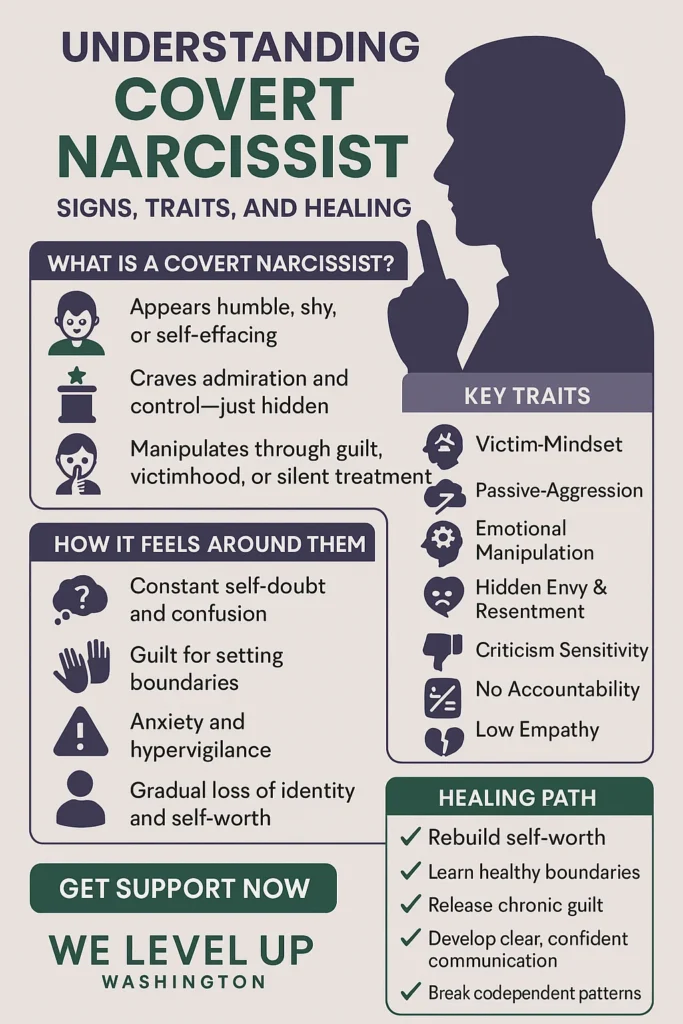
They may even seem shy, insecure, or humble. But behind that gentle exterior is a deep need for admiration, control, and emotional power. A covert narcissist may not yell or brag, but they use guilt, silence, and emotional pressure to keep others off balance.
Instead of direct insults, they cause doubt. Instead of open anger, they use quiet punishment. When you feel weak, insecure, or unsure, a covert narcissist sees an opportunity to gain control. Over time, this pattern can erode your confidence and lead you to question your worth.
We Level Up Washington provides structured and compassionate care for people impacted by covert narcissism.
Skip To
Table of Contents
What Is a Covert Narcissist?
A covert narcissist has the same internal traits as an overt narcissist, but they express them differently. They still crave praise.
They still lack empathy. They still feel entitled to special treatment. But you won’t see the same bold or loud behaviors that overt narcissists show.
Instead, they express their narcissism through:
- Quiet resentment
- Emotional withdrawal
- Guilt-tripping
- Playing the victim
- Subtle blame
- Passive-aggressive comments
A covert narcissist often appears sad or misunderstood, which can make others feel protective of them. But this “soft” approach is part of the manipulation. It allows them to avoid responsibility while still getting sympathy and control.
It’s more important to them than getting attention. They want people to feel bad about their feelings, sorry, or responsible for them. This quiet way of controlling you can be worse because it makes you doubt your own thoughts and make you confused.
How NPD Drives Covert Narcissistic Behavior
Covert narcissists don’t act out for no reason; their actions are caused by the mental wounds of Narcissistic Personality Disorder (NPD). People with NPD feel very insecure, ashamed, and afraid of being found out as “not good enough.” To avoid being open about this, covert narcissists put on a quiet, sensitive, or weak front.
To stay alive, they do things like ignore people, feel guilty, and act like they’re really hurt. They use these tricks to protect their pride, stay in charge, and avoid taking the blame. A small disagreement or set of rules can make someone feel very deeply. This makes many people feel lost, guilty, or like they’re always “on edge.”
When abuse survivors understand how NPD feeds hidden narcissism, they can stop blaming themselves and start seeing the psychological patterns that led to the abuse.
Covert Narcissist Traits
Among the typical covert narcissist traits, the following can be counted:
1. Victim Mentality
Covert narcissists often think that everyone is against them. They feel like no one understands, cares about, or treats them right. They might tell sad stories or make up problems to make you feel sorry for them.
They use phrases like:
- “No one ever appreciates me.”
- “People always take advantage of me.”
- “I guess I’m just not good enough.”
This persistent victim role makes other people feel bad and like they are to blame for their feelings.
2. Passive-Aggressive Behavior
They may:
- Give the silent treatment
- pretend nothing is wrong
- avoid eye contact
- Ignore your needs
- “forget” essential things
- make sarcastic comments
Their anger is quiet but sharp. You feel the tension even when they say nothing.
3. Emotional Manipulation
Covert narcissists use emotions to control the situation. They may guilt-trip you into doing what they want. They may cry or act overwhelmed to avoid blame. They may twist your words to make you feel responsible for their behavior.
For example:
- “I guess I’m just a burden to you.”
- “You made me feel this way.”
- “I tried my best, and you still aren’t happy.”
Over time, you start doubting yourself and changing your behavior to avoid upsetting them.
4. Envy and Quiet Resentment
Covert narcissists do not celebrate others’ success. Instead, they feel threatened. They may pretend to be supportive, but their tone reveals frustration or jealousy.
You may hear comments like:
- You’re lucky. Things never work out for me.
- I suppose some people seem to get all the attention.
They might downplay your accomplishments or avoid acknowledging your good news.
5. Sensitivity to Criticism
Even mild feedback feels like an attack. A covert narcissist may become emotional or withdrawn if you criticize them. They may act hurt or shocked that you would “mistreat” them.
You might notice:
- pouting
- silent treatment
- excuses
- emotional outbursts
- dramatic reactions
Their goal is to avoid taking responsibility by shifting the emotional burden onto you.
6. Lack of Accountability
People who are covert narcissists rarely say they’re wrong. Even when the facts are clear, they are quick to blame someone else. To keep themselves safe, they might change what happened or what was said.
They might say:
- “That’s not what happened.”
- “You’re remembering it wrong.”
- “I only reacted that way because of you.”
Nothing is ever their fault, and you end up feeling confused or guilty.
Confusing Things Covert Narcissists Say
Here are some common things covert narcissists say:
- “You’re just too sensitive.”
- “I was only trying to help.”
- “I guess I’m the bad guy, as usual.”
- “You always misunderstand me.”
- “Why do you always make me feel like a burden?”
- “I never said that.”
Weird Things Covert Narcissists Do
Some weird things covert narcissists do include:
- Silent treatment as punishment: They withdraw emotionally without explanation, leaving you to guess what went wrong.
- Backhanded compliments: “You look nice today,” or “That was pretty good for you.”
- Triangulation: Involving others to validate their version of events or create tension between people.
- Feigning helplessness: They may avoid responsibility by acting as if they are incapable or overwhelmed.
- False humility: Pretending they don’t care about recognition while secretly craving it. Remember, they have an inflated sense of self and feel threatened easily.
These actions may feel small individually, but they add up to a toxic, emotionally abusive pattern.

What it feels like to be around a Covert Narcissist
If you’ve been close to a covert narcissist, such as one of your family members, you may notice the following emotional experiences:
Chronic Self-Doubt
You second-guess yourself constantly.
Emotional Confusion
You feel guilty or responsible for their moods.
Hyper-Vigilance
You try to predict their reactions to avoid upsetting them.
Guilt for Setting Boundaries
Any attempt to say “no” feels like you are hurting them.
Loss of Identity
You slowly forget your own needs, goals, and feelings.
Covert narcissistic abuse is often so subtle that people don’t recognize it as abuse. But the emotional toll is real and deserves serious attention.
How Covert Narcissistic Abuse Impacts the Brain and Body
Covert narcissistic abuse doesn’t only harm your emotions it affects your brain, body, and long-term mental health. Many survivors struggle to understand why they feel drained or “not like themselves” after months or years around a covert narcissist. These effects are real and deeply rooted in the nervous system.
Chronic Stress Response
Living with a covert narcissist often puts your body in a constant fight-or-flight state. You may feel alert, tense, or fearful even during calm moments because your nervous system has learned to expect emotional attacks or silent treatment.
This can cause:
- Headaches
- Stomach pain
- Poor sleep
- Rapid heart rate
- Fatigue
- Brain fog
Cognitive Effects (“Narcissistic Fog”)
Many survivors describe a feeling of being in a mental fog. This narcissistic fog is caused by emotional overload, confusion, and long-term stress.
You may experience:
- Difficulty concentrating
- Forgetfulness
- Second-guessing your memory
- Trouble processing information
- Feeling mentally slow or overwhelmed
This is not a personal failure; it’s a trauma response.
Covert Narcissistic Abuse vs Normal Relationship Conflict
It is important to understand the difference between healthy conflict and emotional abuse.
Normal Conflict Involves:
- Listening
- Shared responsibility
- Real apologies
- Problem-solving
- Respect
Covert Narcissistic Abuse Involves:
- Blame-shifting
- Silent treatment
- Emotional confusion
- Playing the victim
- Making you doubt your memory
- No real accountability
Healthy conflict leads to growth. Covert narcissistic conflict leads to control.
How to Protect Yourself from a Covert Narcissist?
While you may not be able to change a covert narcissist, you can change how you respond and protect your emotional well-being.
1. Recognize the Pattern
Naming the behavior helps break the cycle.
2. Set Clear Boundaries
Be specific about what behaviors are not acceptable.
3. Avoid Emotional Entanglement
Don’t try to correct people with covert narcissism or make them see your perspective. They may use your empathy against you.
4. Focus on Emotional Safety
Prioritize healthy relationships that satisfy your needs.
5. Stop Seeking Their Approval
A covert narcissist is unlikely to provide you with the validation you want. They will feel superior than you.
Why Choose We Level Up?
Being in a relationship with a covert narcissist can leave you feeling emotionally drained and uncertain about your worth. But recognizing the signs is a decisive first step toward healing. Seek help from mental health professionals who are experts in dealing with overt and covert narcissists.
Giving up on an abusive relationship or ending a friendship with a covert narcissist may not be easy. You deserve relationships where your voice matters, your feelings are respected, and your peace is protected. Dealing with a covert narcissist is not a normal experience. Reach out today at We Level Up Washington to get help with covert narcissism.
Experts in Covert Narcissistic Abuse
Our center specializes in helping people affected by both overt and covert narcissists. We understand the quiet psychological pressure that comes from subtle manipulation. Many survivors feel confused because these behaviors are difficult to identify. Our therapists recognize these patterns quickly, so you can gain clarity and understand what really happened.
A Healing Approach That Helps You Understand
When you choose We Level Up, you select a place that helps you:
- Learn about narcissistic abuse in a way that makes sense.
- Find the manipulation that you could have missed or made excuses for.
- Stop doing the same things over and over that keep you caught in the cycle.
- Get your confidence back after years of doubt.
- Learn how to set appropriate limits without feeling bad or scared.
- Learn how to deal with your emotions in a healthy way over time.
- Feel like you have professionals who really understand what you’re going through.
Every breakthrough you make helps you reclaim a part of yourself that was pushed down by emotional control and confusion.
How to Support a Loved One Affected by a Covert Narcissist
Here are ways to help without adding pressure:
1. Listen Without Judgment
Let them share at their own pace.
2. Validate Their Feelings
Reassure them that their emotions are real and understandable.
3. Know Covert Narcissism
Knowledge helps you support them better.
4. Encourage Boundaries
Help them feel safe saying “no” or stepping back.
5. Avoid Forcing Them to Leave
Leaving an abusive dynamic takes courage and time.
6. Suggest Therapy
Professional support can help rebuild stability and confidence. Your support can make a significant difference in their healing process.
Frequently Asked Questions (FAQs)
-
What is the main difference between a covert and overt narcissist?
Overt narcissists are loud, attractive, and make it clear that they want to be admired. Covert narcissists are more withdrawn and manipulative, using passive aggression, guilt, or play the victim to control others quietly.
-
Can covert narcissists change?
Change is possible, but it doesn’t happen very often. Most hidden narcissists don’t want to admit that they are acting in a narcissistic way. Focusing on the well-being of the person affected can help them heal more quickly.
-
Is it narcissistic behavior if someone is just insecure?
Fear of being judged does not equate to being a snob. Consistent patterns of lying, feeling entitled, and not caring about other people show that someone is narcissistic. Covert narcissists often hide these traits by saying they are afraid of being judged.
-
How do I know someone is manipulating me?
You might be with someone narcissistic if you often feel bad, unsafe, or responsible for how they feel. You can figure out what’s wrong and get back in touch with your inner self with the help of counseling.
-
How can I protect myself from a covert narcissist?
Stay calm, don’t argue too much, and don’t share personal secrets. Talking with a counselor can help you feel stronger and safer.
-
Can you have a healthy relationship with a covert narcissist?
It’s very hard. They often want control instead of teamwork. Setting strong boundaries or getting help can make things safer.
-
Why do covert narcissists act kind at first?
They often act sweet and caring to gain your trust. Once you care about them, they start to control or blame you.
-
Do covert narcissists know what they are doing?
Sometimes they do, sometimes they don’t. They are used to putting their needs first and may not realize how much they hurt others.
Final Thoughts
Your journey forward can be filled with clarity, strength, and support. Take the next step toward reclaiming your emotional freedom today.
Call today to speak with our team and learn more about our programs. We Level Up Washington: (509) 348-4077. Your next step starts here.
Medical Sources:
- https://pubmed.ncbi.nlm.nih.gov/22122361/
- https://www.medicalnewstoday.com/articles/covert-narcissist
- https://www.healthline.com/health/covert-narcissist
- https://blog.commonego.com/11-crazy-making-behaviors-of-a-covert-narcissist/