

How to Deal with a Narcissist: Real Help When Someone Close
Dealing with a narcissist can be a complex and challenging experience. Narcissists have an exaggerated sense of self-importance, an insatiable need for admiration, and a lack of empathy for others.
Clinically Reviewed by Lauren Barry, LMFT, MCAP, QS
Medically Reviewed by Ali Nikbakht, PsyD
Updated on February 20, 2026 — Editorial Policy | Research Policy

If you have felt the exhausting pull of someone in your life who always seems to make everything about them. Maybe it is a partner who twists every conversation back to their needs, a parent who dismisses your feelings or a friend who drains you with constant demands for admiration. Dealing with a narcissist can leave you questioning your own reality, feeling small, and wondering if healthy relationships are even possible. You’re not alone in this, and more importantly, you don’t have to stay stuck.
Let’s talk straight about how to deal with a narcissist in a way that protects your heart and helps you feel strong again. Whether the person shows full-blown narcissistic personality disorder (NPD) or just strong narcissistic tendencies, the impact on you is real. The good news? You can learn strategies to set boundaries, protect your emotional health, and decide what kind of contact, if any, feels right for you.
Skip To
Table of Contents
What Does Narcissist Really Mean?
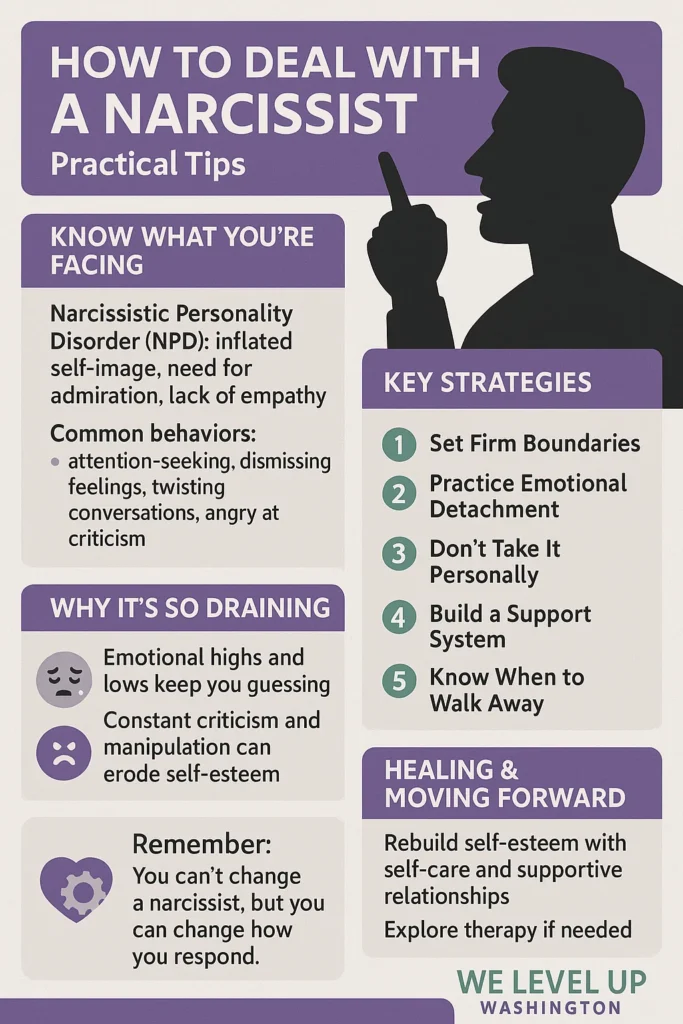
Most people throw the word around when someone acts selfishly. But real narcissistic personality disorder (NPD) is a serious mental health condition. Doctors describe it as a pattern where someone feels way more important than others, craves constant praise, and shows little care for how you feel.
The official guide that therapists use, called the Diagnostic and Statistical Manual of Mental Disorders (DSM-5), lists clear signs. You need at least five for a true diagnosis. Here are the main narcissistic traits people notice every day:
- They act like they’re better than everyone else and deserve special treatment
- They brag a lot or dream about unlimited power, success, or beauty
- They believe only special people can understand them
- They need you to admire them all the time
- They use others to get what they want without feeling bad
- They show a big lack of empathy – your pain doesn’t matter to them
- They feel jealous of others or think others are jealous of them
- They act arrogantly or rudely when things don’t go their way
- They get very upset or angry if you criticize them, even a little
These behaviors hurt relationships badly. If this sounds like your friend, family member, or partner, you’re dealing with narcissistic behavior that can leave you emotionally abused.
End the Emotional Pain. Get Your Life Back.
Feeling Depressed, Anxious or Struggling with Mental Health Illness? Get Safe Comfortable Mental Health Dual Diagnosis High-Quality Therapy From Counselors That Care. Begin Your Recovery Now.
Hotline: (509) 348-4077

Why Do They Act This Way?
People with strong narcissistic tendencies often hide deep hurt or low self-worth under all that bragging. Criticism feels like an attack because they’re hypersensitive to criticism inside. That doesn’t make it okay to hurt you. It just explains why arguing or begging them to change almost never works. They protect their big ego at any cost – even if it breaks family dynamics or healthy relationships.
How Narcissists Hurt the People Around Them
When you love someone with NPD, life feels like walking on eggshells. Common things happen:
- They blame you for everything, even when it’s their fault
- They make promises but never follow through
- They give you the silent treatment or explode in rage
- They make you question your own memory (that’s called gaslighting)
- They play the victim when you try to talk about your feelings
Over time, this drains you. You might feel anxious, depressed, or worthless. Many people end up needing help from mental health services just to heal.
Get Help. Get Better. Get Your Life Back.
Searching for Accredited Dual Diagnosis Mental Health Centers Near You?
Even if therapy failed previously, or are in the middle of a difficult crisis, we stand ready to support you. Our trusted behavioral health specialists will not give up on you. When you feel ready or just want someone to speak to about counseling alternatives to change your life call us. Even if we cannot assist you, we will lead you to wherever you can get support. There is no obligation. Call our hotline today.
FREE 24/7 Dual Diagnosis Mental Health Services HotlineHow to Deal with a Narcissist: Steps That Actually Work
You can’t change them – only they can do that, and most don’t want to. The good news? You can protect yourself and start feeling better today. Here’s what really helps when you’re dealing with a narcissist:
Learn the Signs So You Stop Blaming Yourself
The first big step is seeing the truth. Once you know these patterns come from their mental health condition, not from you not being good enough, everything changes. You stop trying so hard to please them.
Set Healthy Boundaries (And Stick to Them)
Boundaries are rules about what you will and will not accept. People with narcissistic personality disorder hate them, but you need them to stay safe.
Try saying calm, clear things like:
- I won’t stay in the room if you yell at me.
- I need time alone after we argue.
- Please don’t talk about my weight/friends/money.
Then follow through. Leave the room. Hang up the phone. They might get mad at first, but strong healthy boundaries teach them you mean business.
Comfortable Facilities & Amenities
High-Quality Mental Health Services & Behaviroal Health Substance Abuse Treatment
Rehab Centers TourRenowned Mental Health Centers. Serene Private Facilities. Inpatient Rehab Programs Vary.
Mental Health Helpline: (509) 348-4077Proven recovery success experience, backed by a Team w/ History of:
15+
Years of Unified Experience
100s
5-Star Reviews Across Our Centers
10K
Recovery Success Stories Across Our Network
- Low Patient to Therapist Ratio
- Comprehensive Dual-Diagnosis Treatment
- Complimentary Family & Alumni Programs
- Coaching, Recovery & Development Events
- Comfortable Onsite Medical Detox Center
Stop Arguing – Use the Gray Rock Method
Narcissists love drama because it gives them attention. When you fight back or cry, they feel powerful. Instead, act boring like a gray rock.
Give short, dull answers:
- Okay.
- I see.
- Maybe.
No emotion. No details about your life. This starves their need for reaction.
Build a Strong Support Network
Talk to safe friends or family who believe you. Join an online support group for people who grew up with or dated narcissists. Having a support system reminds you that you’re lovable and normal.
Prioritize Self-Care and Healing
Reclaim your energy through therapy, journaling, exercise, or hobbies that light you up. Cognitive behavioral therapy (CBT) helps rewire negative beliefs planted by narcissistic abuse and helps us to learn how to handle a narcissist.
If you’ve experienced prolonged emotional abuse, consider trauma-focused approaches like EMDR.
Decide How Much Contact You Really Want
Sometimes, low contact or no contact is the kindest thing you can do for yourself. This is extra true with a narcissistic abuser. You don’t owe anyone your peace, even if they’re family.

How to Deal with a Narcissistic Parent (Special Tips)
Growing up with a narcissistic parent leaves deep scars. As an adult, you might still feel like a kid around them. Many people find freedom by limiting visits, keeping talks short, and not sharing personal news. Therapy helps a ton because you learn you didn’t deserve the way they treated you.
When to Get Professional Help
If you’re feeling hopeless, having panic attacks, or thinking about hurting yourself, reach out to We Level Up WA. A good therapist who understands narcissistic abuse can guide you step by step. You deserve to feel safe and happy again.
Frequently Asked Questions (FAQs)
-
Where in Spokane Valley, Washington, can you find treatment for narcissistic abuse recovery?
We Level Up Washington in nearby areas provides specialized therapy for those recovering from narcissistic relationships, focusing on trauma-informed care and rebuilding healthy boundaries.
-
Where in Coeur d’Alene, Idaho, can you find support after dealing with a narcissist?
Just a short drive away, We Level Up Washington welcomes clients from Coeur d’Alene and surrounding areas for comprehensive mental health treatment tailored to narcissistic abuse survivors.
-
Is it possible to maintain a relationship with someone who has narcissistic personality disorder?
Sometimes, with very strong boundaries and low expectations. But if the relationship consistently harms your mental health, distancing yourself—even fullyis a valid, healthy choice.
-
Will a narcissist ever change?
Change requires deep self-awareness and long-term therapy, which many resist.
-
How do I know if I’m being emotionally abused by a narcissist?
Persistent belittling, gaslighting, control, or isolation are red flags. Trust your feelings if interactions leave you drained, anxious, or worthless, that’s meaningful.
-
Can therapy help me cope with a narcissistic family member?
Absolutely. A skilled therapist teaches boundary-setting, emotional regulation, and reframing childhood narratives that keep you stuck.
-
What’s the difference between healthy confidence and narcissistic tendencies?
Confidence lifts others up too. Narcissism demands others stay small to feel big.
-
How can I rebuild my self-esteem after narcissistic abuse?
Start with small acts of self-kindness, surround yourself with supportive people, and celebrate your strengths daily. Healing takes time, but it happens.
Final Words
The way you have been treated is not your fault, and you do not have to keep accepting it. Every small step you take, learning the truth, setting one boundary, talking to one safe person, brings you closer to peace. Healing is possible. You can build healthy relationships full of real love and respect. You’re stronger than you know, and there are people ready to walk with you.
Call We Level Up Washington at (509) 348-4077 to get personalized support for narcissistic abuse recovery and start rebuilding your confidence today.
Medical source
https://health.osu.edu/health/mental-health/how-to-identify-a-narcissist
https://medlineplus.gov/ency/article/000934.htm
https://pubmed.ncbi.nlm.nih.gov/35447664/
https://www.ncbi.nlm.nih.gov/books/NBK556001/