

Anhedonia Symptoms & Treatment for Loss of Pleasure
The sensation of joy is one that almost everyone can relate to. They have predetermined ideas about what will make them happy. Perhaps you find solace in the cycling motion, the sea’s soothing sounds, or the touch of another person’s hand. However, some people gradually stop experiencing happiness. Things that used to bring them joy no longer do so. Lack of pleasure; that’s anhedonia.
Clinically Reviewed by Lauren Barry, LMFT, MCAP, QS
Medically Reviewed by Ali Nikbakht, PsyD
Updated on January 27, 2026 — Editorial Policy | Research Policy

Feeling joy is part of being human. We enjoy food, music, friends, laughter, and small moments. But for some people, joy feels missing. They may want to feel happy, but cannot. This experience is called anhedonia.
Anhedonia symptoms can make life feel empty. People may stop enjoying things they once loved. They may feel numb, flat, or disconnected. This can be confusing and painful, especially when others do not understand.
This article explains what anhedonia is, its common symptoms, why it happens, how it affects the brain, and options for treating it. Everything is written in straightforward words to make it easy to understand.
Skip To
Table of Contents
What Is Anhedonia?
Anhedonia is defined as a reduced ability to experience pleasure. It means a person has trouble feeling joy, interest, or a sense of reward.
Doctors often describe it as a loss of pleasure disorder. This does not mean someone is lazy or ungrateful. It means the brain is not responding to pleasure in the usual way.
This is a real mental health condition and a severe symptom that deserves care and attention.
How Pleasure Works in the Brain
Pleasure is not just an emotion. It is a brain process.
The brain uses something called reward processing. This system helps us:
- Feel motivated
- Enjoy food and connection.
- Learn what feels good.
- Repeat healthy behaviors
Dopamine is an important brain neurotransmitter in this system. When reward processing is working properly, we feel good and interested. Joy feels obstructed when it doesn’t.
Anhedonia Symptoms: What People Experience
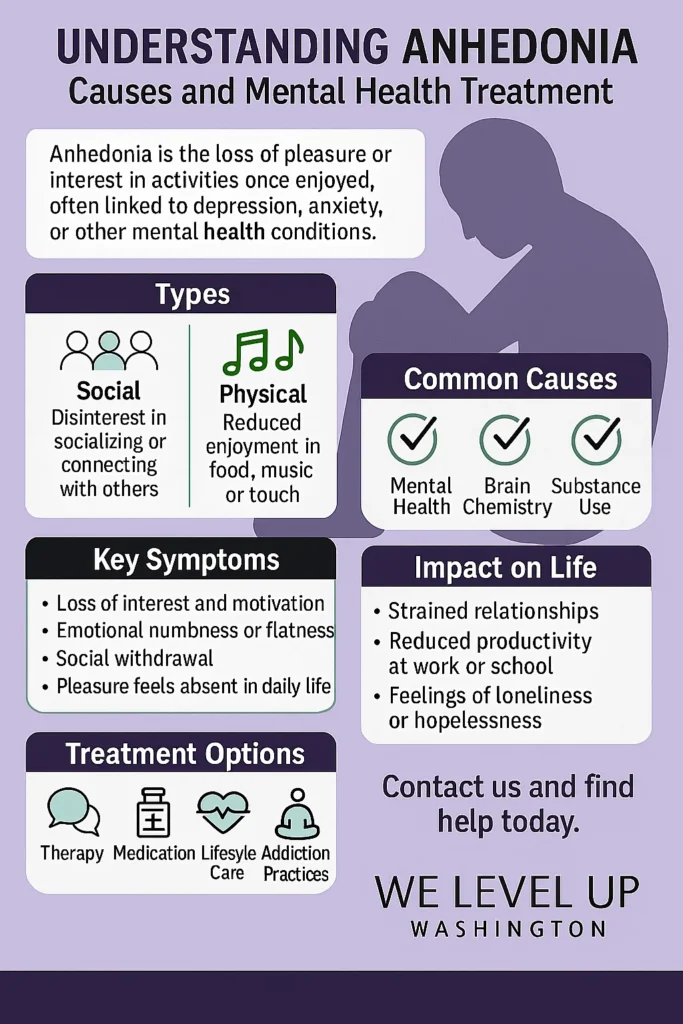
Anhedonia symptoms can look different for each person. Some people feel them slowly. Others notice sudden changes.
Emotional Symptoms
- Feeling numb or empty
- No excitement
- Trouble feeling love or closeness
- Feeling flat or dull
- Lack of emotional reaction
Daily Life Symptoms
- No interest in hobbies
- Food has no pleasure.
- Music feels boring
- No motivation
- Avoiding social activities
These symptoms can lead to social withdrawal, where people pull away from friends, family, and activities.
End the Emotional Pain. Get Your Life Back.
Feeling Depressed, Anxious or Struggling with Mental Health Illness? Get Safe Comfortable Mental Health Dual Diagnosis High-Quality Therapy From Counselors That Care. Begin Your Recovery Now.
Hotline: (509) 348-4077


Social and Physical Pleasure Loss
Doctors often describe two types of pleasure loss.
Social Pleasure Loss
This affects the enjoyment of people:
- Avoiding friends
- Not enjoying conversations
- Feeling distant from loved ones
Physical Pleasure Loss
This affects enjoyment from experiences:
- Eating feels empty
- Touch feels neutral
- Activities feel boring
Many people experience both.
Anhedonia and Major Depressive Disorder (MDD)
Loss of pleasure is a key symptom of major depressive disorder (MDD).
Some people with depression do not feel deeply sad. Instead, they feel nothing. This emotional numbness can be the most painful part.
In major depressive disorder, anhedonia symptoms may appear with:
- Low energy
- Hopelessness
- Sleep problems
- Low self-worth
- Poor concentration
Other Mental Health Conditions Linked to Pleasure Loss
This problem is not only linked to depression.
It may also appear with:
- Anxiety disorders
- PTSD
- Bipolar disorder
- Schizophrenia
- Substance use disorders
Get Help. Get Better. Get Your Life Back.
Searching for Accredited Dual Diagnosis Mental Health Centers Near You?
Even if therapy failed previously, or are in the middle of a difficult crisis, we stand ready to support you. Our trusted behavioral health specialists will not give up on you. When you feel ready or just want someone to speak to about counseling alternatives to change your life call us. Even if we cannot assist you, we will lead you to wherever you can get support. There is no obligation. Call our hotline today.
FREE 24/7 Dual Diagnosis Mental Health Services HotlineCauses of Anhedonia
There is no single cause. Many causes of anhedonia work together.
Brain Chemistry Changes
Dopamine and serotonin may be out of balance.
Long-Term Stress
Stress can reduce the brain’s reward response.
Trauma
Trauma can cause emotional shut-down as protection.
Depression and Mood Disorders
These conditions affect reward pathways.
Substance Use
Drugs and alcohol can damage reward processing over time.
How Doctors Diagnose Anhedonia
Doctors listen to your symptoms and may use tools that measure how much you enjoy things.
There is a tool called the Snaith-Hamilton Pleasure Scale (SHAPS), also known as the Hamilton Pleasure Scale.
Questions on the Snaith Hamilton Pleasure Scale are about how much you enjoy your daily life. It helps figure out:
- Severity of symptoms
- Progress during treatment
Why It Feels So Distressing
Many people say loss of pleasure feels worse than sadness.
Why?
- It removes hope
- It blocks motivation
- It disconnects meaning
- It makes life feel empty.
Can the Ability to Experience Pleasure Return?
Yes. The ability to experience pleasure can be reestablished.
We are slowly getting better. It takes time for the brain to heal. A lot of the time, small moments come back first and then get bigger over time.
Treating Anhedonia: What Helps
Treating anhedonia focuses on healing the brain and restoring reward processing.
Therapy
Therapy helps reconnect emotions:
- Cognitive Behavioral Therapy
- Trauma-informed therapy
- Group therapy
Medication
Some medications help balance brain chemicals.
Behavioral Activation
Small actions help the brain relearn the experience of reward.
Substance Use Treatment
Stopping substances helps reward systems heal.
Comfortable Facilities & Amenities
High-Quality Mental Health Services & Behaviroal Health Substance Abuse Treatment
Rehab Centers TourRenowned Mental Health Centers. Serene Private Facilities. Inpatient Rehab Programs Vary.
Mental Health Helpline: (509) 348-4077Proven recovery success experience, backed by a Team w/ History of:
15+
Years of Unified Experience
100s
5-Star Reviews Across Our Centers
10K
Recovery Success Stories Across Our Network
- Low Patient to Therapist Ratio
- Comprehensive Dual-Diagnosis Treatment
- Complimentary Family & Alumni Programs
- Coaching, Recovery & Development Events
- Comfortable Onsite Medical Detox Center
How Anhedonia Symptoms Affect Relationships and Social Life
A person’s interactions with others can change over time due to anhedonia symptoms. People may still care about their family and friends, but being with them may not make them happy. Social withdrawal is a common result. Someone might stop calling their friends and family, avoid social events, or spend more time alone.
There is no lack of love behind this withdrawal. It happens because the brain isn’t receiving rewards the way it should. It might get old to talk to people. It might feel awkward to laugh. An emotional bond might seem far away.
Friends and family may start to think the person doesn’t care about them anymore over time, which can make them feel confused or hurt.
A lot of people who have this loss-of-pleasure disorder feel bad when they pull away. They might want to connect but not be able to enjoy it. This can make you feel more alone and stressed, worsening your symptoms. People who have major depressive disorder (MDD) often go through this pattern because losing pleasure is a typical sign of MDD.
It can help to talk clearly. Relationships often get better when both sides understand that this is a mental illness and not a choice. Therapy can help people talk about how they feel and slowly get back together. Supportive emotions allow the brain heal even when there isn’t much pleasure in life.
How Loss of Pleasure Impacts Work, Motivation, and Daily Life
Loss of pleasure can also make it hard to stick to personal goals, daily routines, and a job. What used to feel like a fun task may now seem useless. Because of changes in the brain, it doesn’t react the same way to good things anymore. Because of this, desire often goes down.
Some people may find it hard to concentrate or finish their work at school or at work. Getting something done might not make you feel proud or relieved. This can hurt your confidence and make you more stressed over time. Some people may feel like they’re failing, but the real problem is how their brains function.
Daily activities can also feel empty. Food may have no taste. Music may feel flat. Hobbies may feel boring. This can make days feel long and repetitive. Many people describe life as feeling “gray” or emotionally distant.The stress brought on by these issues may further impair one’s ability to experience pleasure. It is important to get help early in this stage. Over time, treating anhedonia helps things return to order. One tool doctors may use to track progress is the Snaith-Hamilton Pleasure Scale (SHAPS).
It takes a long time to get better. A lot of the time, interesting little things happen first. Every day life can start to have value again with care, help, and time.
Why Choose We Level Up for Anhedonia Symptoms
Choosing the right support matters. We Level Up Washington provides compassionate care for people struggling with anhedonia symptoms as part of mental health or substance use recovery.
At We Level Up, individuals receive:
- Mental health treatment
- Dual-diagnosis care
- Trauma-informed therapy
- Support for depression and mood disorders
- Structured recovery planning
The goal is to help people feel again, safely and slowly.
When to Seek Professional Help
Seek help if:
- Loss of pleasure lasts weeks or months.
- Social withdrawal increases
- Life feels empty or meaningless.
- Depression symptoms grow
Early support leads to better outcomes.
Frequently Asked Questions (FAQs)
-
What are anhedonia symptoms?
Loss of pleasure, emotional numbness, low motivation, and little enjoyment from tasks or relationships are all symptoms of anhedonia.
-
What is anhedonia?
As a recognized mental health condition, anhedonia is defined as a decreased ability to experience pleasure.
-
Is it a symptom of depression?
Yes. It is one of the significant symptoms of major depressive disorder (MDD).
-
How is it measured?
Doctors may use the Snaith-Hamilton Pleasure Scale (SHAPS) to assess changes in pleasure over time.
-
Can it be treated?
Yes. Treating anhedonia may include therapy, medication, lifestyle support, and help for underlying causes.
-
Does pleasure come back?
Yes. With time and proper care, reward processing can improve, and joy can return.
World-class, Accredited, 5-Star Reviewed, Effective Mental Health Dual Diagnosis Programs. Complete Integrated Inpatient Rehab with Free Post Discharge Therapy Planning.
Hotline: (509) 348-4077End the Emotional Pain Rollercoaster. Gain Stability & Happiness Through Recovery Treatment. Start Mental Health Counseling Today. Get Free No-obligation Guidance by Behaviroal Health Specialists Who Understand Mental Health Recovery.
Conclusion
Help is available if you or someone you care about is experiencing symptoms of anhedonia. It can be painful to feel cut off from happiness, but it doesn’t have to last forever. The brain can heal, and mental connections can come back with the right help.
Kind mental health and healing care is available at We Level Up Washington in a safe, supportive environment. An admissions expert who cares can answer your questions and help you look into your treatment options.
Call (509) 348-4077 now to take the first step toward reconnecting with life, meaning, and hope.